Pintu Pro: high-frequency trading for market makers
Grew the Pintu Pro team from 5 backend engineers to 21 people across six disciplines, and led it end to end to launch an exchange that matches orders in under 100 ms at 10,000 transactions per second.
Role
Engineering Manager, promoted to Senior Engineering Manager
Team
5 → 21 people across 6 disciplines
Timeline
Feb – Sep 2023 (to production)
Domain
Crypto trading · Market making
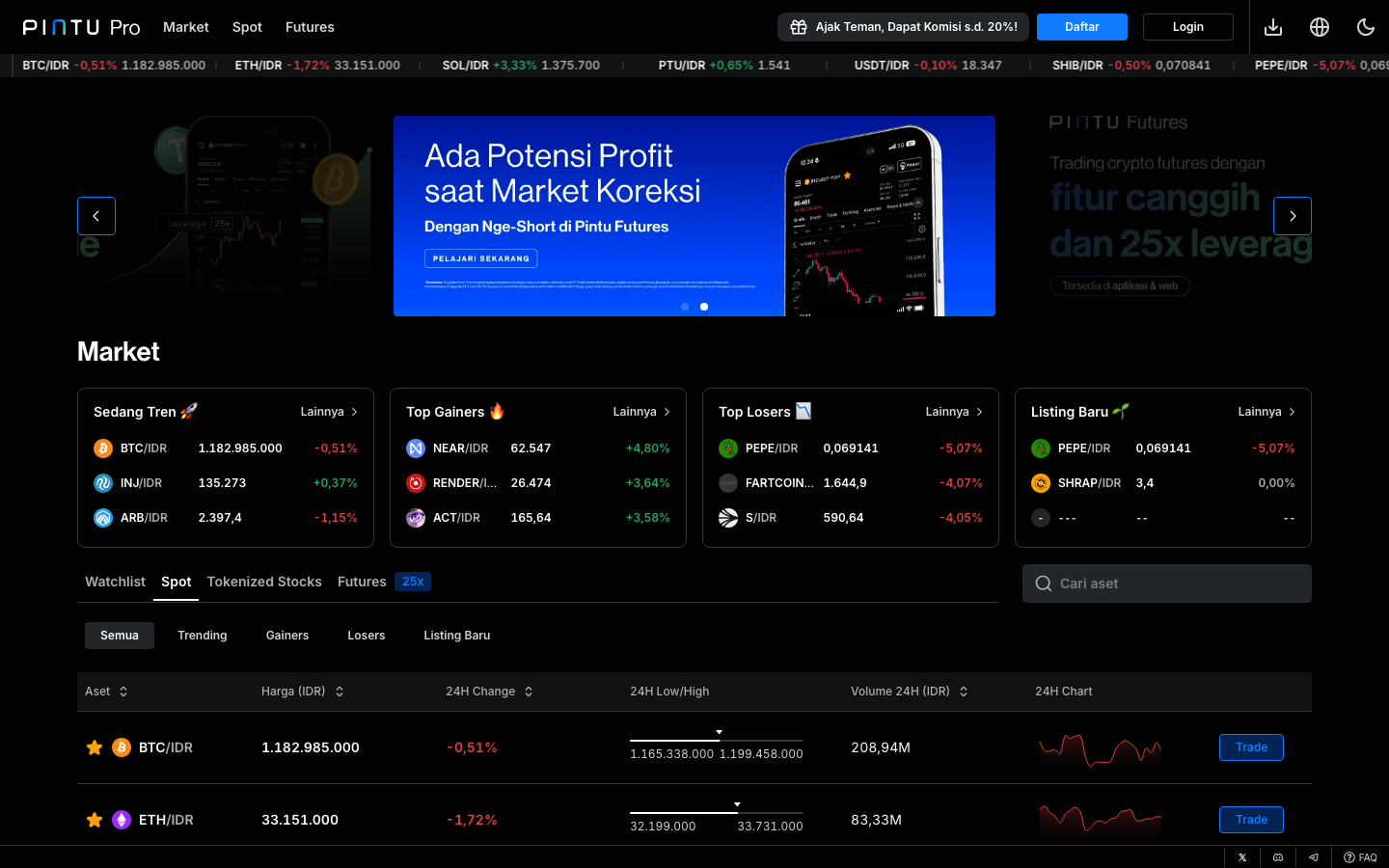
Pintu Pro markets page, pintu.co.id/pro.
The challenge
Run our own order book, and make it fast enough for market makers
Pintu started as a crypto app for everyday investors in Indonesia, with prices that depended on other exchanges. Pintu Pro changed that: by running its own order book, Pintu no longer had to rely on other exchanges and could offer users more competitive prices.
An order book is only as good as the liquidity in it, and that liquidity comes from market makers. They quote continuously, react to global price moves in milliseconds and leave the moment a venue feels slow or unfair. Without them, the book is thin and every other user gets worse prices.
The question wasn’t just “can we build an exchange?” but “can we run one that market makers want to stay on?”
01Latency. The full round-trip, from an order coming in, to it landing in the order book, to the status update reaching the user, had to stay under 100 ms.
02Throughput. The target was 10,000 transactions per second, with thousands of users trading at the same time.
03Exchange rules. Matching had to be strictly first come, first served, as on any exchange, and prices had to track the global market. The system had to support how market makers actually behave. Regulation also required a demo so new users could understand Pro easily; that shaped the product, not the system design.
04One product, six disciplines. Frontend, backend, QA, SRE, data and engineering management had to ship as one team.
My role
Owning Pintu Pro end to end
I joined Pintu Pro as an Engineering Manager and was promoted to Senior Engineering Manager during the project, managing two Engineering Managers. I owned the product end to end across backend, frontend, infrastructure, QA and data, and worked directly with Product, Business and the market makers themselves.
01People. Grew the team from 5 backend engineers to 21 people, adding frontend, QA, SRE, data and two Engineering Managers.
02Architecture. Set the performance targets and made the core design calls, including how matching engines map to tokens.
03Market makers. The engineering point of contact during onboarding and in day-to-day operations.
04Regulator audit. Represented the engineering department in the OJK audit, which came back with good feedback.
Approach
How we built it
1. Team shape
We started as a small backend team focused on the core: the order book and matching. As the product took shape, I built out the rest of the team around it (frontend, QA, SRE and data) and brought in two Engineering Managers so each part of the team had a dedicated lead.
2. Architecture
Every design choice was measured against two numbers: under 100 ms round-trip and 10,000 TPS. Matching followed strict first-come-first-served ordering, prices tracked the global market, and each token got its own matching engine so one busy market couldn’t slow down another. The services were written in Go, talked to each other over gRPC and passed messages through Kafka, with Datadog and Grafana for monitoring.
3. Working with market makers
We had API documentation ready before onboarding started, then ran several technical meetings with each market maker to get them live. After launch, a dedicated channel with each of them handled day-to-day operations. They connected from different locations and regions, and the system served all of them.
4. Paying back efficiency later
We launched with a setup that prioritised speed and isolation over cost. Once Pro was stable, we followed up with a cost-saving roadmap that merged the parts that were least efficient.
Simplified order flow. Market makers quote off global prices; each token runs on its own matching engine.
Key decisions
Trade-offs we made on purpose
Decision 01
Our own order book instead of other exchanges’ prices
Running our own exchange meant Pintu’s prices no longer depended on other exchanges, so we could offer users more competitive prices.
Trade-off: Liquidity became our problem. The order book had to attract market makers and keep them.
Decision 02
One matching engine per token
Instead of sharing a matching engine across several tokens, each token got its own engine. That isolated the markets and made the latency target easier to hold at launch.
Trade-off: It was wasteful, since one engine could handle several tokens. We put efficiency aside at first and later merged the least efficient parts on a cost-saving roadmap.
Decision 03
Built for market maker behaviour
Strict first-come-first-served matching and prices that track the global market, so market makers could trade on Pintu Pro the same way they trade on other exchanges.
Trade-off: These rules left no room for shortcuts, so every component had to fit within the 100 ms budget.
Outcome
What changed
<100 ms
Order round-trip, from order in to status update
10k TPS
Transactions per second
5,000+
Users trading concurrently
Pintu Pro served multiple market makers across different locations and regions, and gained hundreds of thousands of users in the first few months after launch.
What I learned
What I’d keep, and what I’d change
I’d build better operational tools from day one. Once Pro was live with real market makers, day-to-day operations became a big part of the work, and the right tooling from the start would have made that easier for the team.